
What is Electroplating?
Electroplating is a process that uses electricity to deposit a thin layer of one metal onto the surface of another, giving the underlying part properties it didn’t have on its own. The most common reasons to prunlate a part are to make it more resistant to corrosion, harder, more conductive, or simply better-looking.
If you’ve ever picked up a zinc-coated bolt, a nickel-plated bracket, or a chrome bumper, you’ve held an electroplated part.
Why Electroplating Matters
For manufacturers, electroplating is one of the most cost-effective ways to extend the life and performance of metal components. A part that would rust within months can last for years. A part that wears out quickly under friction can become hard enough to outlast the assembly around it. A part that needs to conduct electricity better, solder more cleanly, or simply look more finished can be transformed in a single processing step.
The benefits that drive most of the work we do at CMC:
-
Corrosion resistance. Protection against moisture, road salt, fertilizers, soil, and harsh industrial environments.
-
Wear resistance. Increased hardness and lubricity for parts that move, slide, or take repeated impact.
-
Conductivity. Improved electrical performance for contacts, busbars, and battery components.
-
Solderability. Cleaner, more reliable connections in electronics and assembly work.
-
Aesthetic finish. A consistent, uniform appearance for visible components.
Common Applications
Electroplated parts are everywhere in modern manufacturing. The processes we run at CMC are most often applied to:
-
Fasteners (bolts, nuts, screws, clips)
-
Brackets and stampings
-
Hydraulic and brake-line components
-
Electrical connectors and terminals
-
Battery and charging-station hardware
-
Agricultural and construction equipment parts
-
Powertrain and chassis components
Different industries lean on different plating chemistries. An automotive fastener might require zinc-nickel for corrosion protection in salt environments. An electronics connector might require tin for solderability. An aerospace bushing might require electroless nickel for uniform thickness on complex geometry. Choosing the right plating starts with the operating environment, the substrate, and the spec.
How Electroplating Works
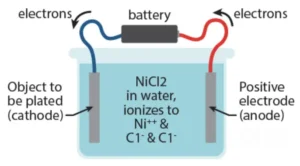
Electroplating is the deposition of a metallic coating onto an object by putting a negative charge onto the object and immersing it into a solution which contains a salt of the metal to be deposited. The metallic ions of the salt carry a positive charge and are attracted to the part. When they reach it, the negatively charged part provides the electrons to “reduce” the positively charged ions to metallic form.
In practice, imagine an object made of copper or steel that has been properly cleaned, and that we now want to plate with nickel. A wire is attached to the object, and the other end of the wire is attached to the negative pole of a battery. To the positive pole of the battery we connect the red wire; the other end of the red wire connects to a rod made of nickel. Now we fill the cell with a solution of a salt of that metal to be plated. Because the object to be plated is negatively charged, it attracts the positively charged Ni. The Ni ions reach the object, and electrons flow from the object to the Ni. For each atom of Ni, two electrons are required to neutralize it (or “reduce” it) to metallic form. At the anode, electrons are removed from the nickel metal, oxidizing it to the Ni++ state. The nickel rod dissolves at the rate it plates onto the object, supplying replacement nickel for what has been plated out, and we retain a solution of nickel chloride in the cell.
Types of Electroplating
Not all electroplating is the same. The right process depends on the substrate, the operating environment, the tolerances, and the cost target. At CMC we run a range of finishes:
- Zinc and zinc alloys (zinc, zinc-nickel, zinc-iron). Workhorses for corrosion protection across automotive, agricultural, and industrial applications.
- Electroless nickel. A chemical (not electrical) deposition process that produces highly uniform thickness, even on complex internal geometry.
- Tin and tin alloys. Soft, solderable finishes used in electronics and food-contact applications.
- Nickel. Hard, corrosion-resistant, often used as an underlayer or for aesthetic and wear-resistance reasons.
A full breakdown of our processes, with the rack-and-barrel availability of each, is on our Capabilities page.
Ready to Plate Your Parts?
If you’re trying to figure out which plating is right for your application, we can help. Send over a drawing or a description and we’ll recommend the right process based on the substrate, the operating environment, and the spec.
Request a Quote · See our Capabilities · Industries We Serve